
Solar Energy as a Service (EaaS)
A Smarter Way for Thai Businesses to Go Solar
If you run a hotel, resort, or retail business in Thailand, you already know that electricity is one of your largest recurring monthly operating expenses. With commercial electricity rates commonly around 4–5.5 THB per kWh depending on tariff and usage profile, and the fuel adjustment charge (Ft) subject to periodic adjustment, that bill is not likely to get smaller on its own.
Many business owners we speak with have looked at solar at some point, perhaps even received a quote, but still haven’t made the move. The most common reason? The upfront cost. A commercial solar system that can meaningfully reduce your bills typically requires a capital investment of several hundred thousand to several million Baht. For a business owner focused on keeping cash in the business, that can be a difficult conversation.
That’s exactly why the Energy as a Service (EaaS) model is gaining serious traction in Thailand — and why we think it deserves a proper explanation.
What Is Solar Energy as a Service (EaaS)?
Energy as a Service is an outcome-based financing model where a provider — in this case, Kunini — designs, funds, installs, owns, operates, and maintains a solar energy system on your property. You don’t purchase the equipment. You don’t take on the technical risk. Under Kunini’s EaaS model, customers pay a fixed monthly fee in exchange for the energy and services delivered. That fee is agreed upfront and does not fluctuate with how much energy is generated. Kunini’s typical agreements run for eight to ten years, rather than ten to fifteen under a traditional PPA.
Think of it this way: rather than buying a generator and hiring someone to maintain it, you simply pay for the electricity it produces. EaaS applies the same logic to solar — but takes it several steps further.
Under a true EaaS agreement, the scope of what the provider manages is significantly broader than a traditional energy contract. It can include:
- Solar PV system design and installation
- Battery storage and hybrid system management
- Energy monitoring and performance reporting
- Scheduled maintenance and remote diagnostics
- EV charging infrastructure
- Energy management software and optimisation
- Insurance and compliance support
The customer’s role is simple: use the energy, pay the agreed service fee, and focus on running their business.
The global Commercial EaaS market is projected to grow at a CAGR of around 8.9% through the early 2030s — and Thailand is very much part of that story. Keppel has secured EaaS contracts in Bangkok for Centara Watergate and Watergate Pavilion, alongside wider EaaS agreements covering cooling, solar PV and EV charging.
How EaaS Differs from a Traditional Solar PPA
At first glance, EaaS and a Power Purchase Agreement (PPA) can look similar. Both involve no upfront capital from the customer. Both allow businesses to access solar energy without owning the hardware. But the differences matter — especially for businesses that want more than just cheaper electricity.
The Traditional Solar PPA
A Private PPA is a long-term agreement — typically 10 to 15 years — between your business and a solar developer. The developer funds and installs the system on your rooftop, owns it throughout the contract, and sells you the solar electricity it generates at a pre-agreed rate. That rate is typically set below your current PEA or MEA tariff, so you save money from day one.
Kunini already offers this model for businesses across Thailand, and it works well. The key features of a PPA are:
- Zero upfront investment from the customer
- Fixed or escalating per-kWh rate for the solar electricity produced
- Ownership by the developer throughout the contract term
- Asset transfer to the customer at the end of the agreement
- Maintenance and monitoring handled by the provider
For many businesses, a Private PPA is the right solution — particularly those with straightforward energy profiles and a clear desire to reduce their electricity bill.
Where EaaS Goes Further
EaaS evolves the PPA concept into a broader, outcomes-based service relationship. The shift is both practical and philosophical.
With a traditional PPA, you are buying electricity — kilowatt-hours produced by a specific solar asset on your roof, billed at a per-unit rate over a long contract term. With EaaS, you are buying energy outcomes — a guaranteed level of energy performance delivered through a fixed monthly fee over a shorter, more flexible agreement. Your cost is known from day one and does not vary month to month based on weather or system output.
| Feature | Kunini PPA | Kunini EaaS |
|---|---|---|
| Payment basis | Per kWh of solar generated | Fixed monthly fee — predictable, regardless of generation variance |
| Contract term | Typically 10–15 years | Typically 8–10 years — shorter commitment |
| Scope | Solar generation only | Solar + storage + EV + energy management + more |
| Performance guarantee | System uptime and generation estimates | Guaranteed energy outcomes and savings targets |
| Technology scope | Single asset (solar PV) | Multi-technology (solar, batteries, cooling, EV charging) |
| Energy management | Basic monitoring | Active optimisation and demand management |
| Flexibility | Fixed contract structure | Can evolve as your business needs change |
| Best for | Businesses with straightforward energy needs | Businesses seeking a fully managed, shorter-term, outcome-guaranteed energy partner |
Put simply: a PPA is a product. EaaS is a partnership.
For a hotel trying to reduce electricity costs while also meeting ESG reporting targets, achieving Green Hotel certification, and planning EV charging for guests, EaaS provides a unified framework to address all of those goals through one provider and one contract.
How the EaaS Model Works in Practice
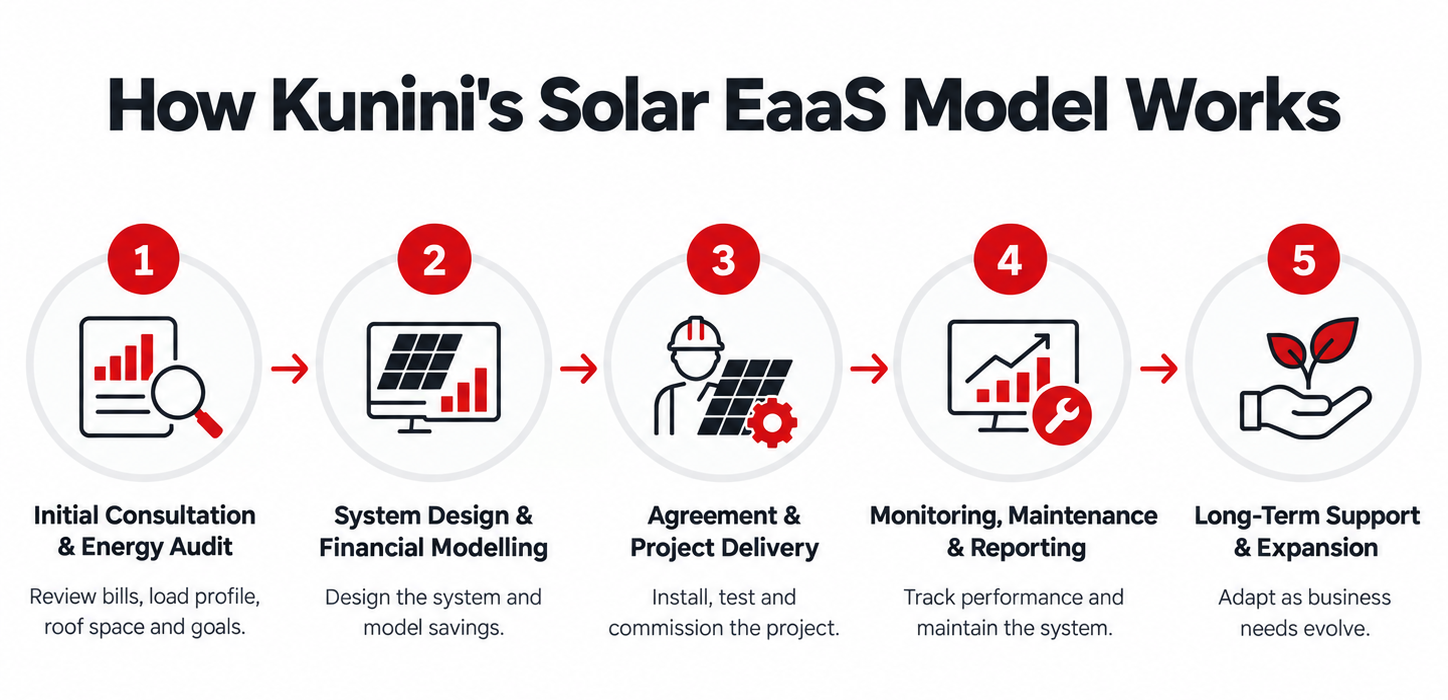
Whether you’re a hotel owner in Hua Hin or a retail centre manager in Pattaya, the EaaS process with Kunini follows a clear and transparent path.
Step 1 — Initial Consultation and Energy Audit: We start by understanding your business: your electricity bills, operating hours, consumption profile, available roof space, and your goals. For a hotel, that means understanding your HVAC load, pool pumps, kitchen equipment, and guest room demand. For a retail centre, it means mapping your lighting, air conditioning, escalators, and anchor tenant usage. We look at the full picture.
Step 2 — System Design and Financial Modelling: Kunini’s in-house engineering team designs a system tailored to your consumption profile. We model the financial outcomes: projected savings versus your current PEA or MEA tariff, the proposed service fee structure, the environmental impact, and the contract terms. You see the numbers before you sign anything.
Step 3 — Agreement and Project Delivery: Once you’re comfortable with the proposal, Kunini manages the entire delivery — engineering, procurement, installation, testing, commissioning, and all relevant utility compliance (including Zero Export compliance where required by PEA or MEA). We work around your operations so disruption is minimal.
Step 4 — Ongoing Management: From the day the system goes live, Kunini handles everything: real-time performance monitoring, remote diagnostics, scheduled maintenance, equipment insurance, and monthly reporting. You receive a clear, straightforward report each month showing energy produced, savings delivered, and system health.
Step 5 — Long-Term Relationship: EaaS is not a transactional relationship. As your business grows or your energy needs evolve — perhaps you add EV charging stations, expand your rooftop area, or require battery storage — the agreement can be adapted to reflect those changes. At the end of the contract term, the energy assets transfer to you.
Why Hotels and Retail Centres in Thailand Are a Natural Fit
Not every business is equally suited to EaaS. The model works best where there is a strong, consistent daytime electricity load, reliable long-term occupancy of the property, and a genuine desire to reduce operating costs without tying up capital.
Hotels and resorts in Thailand check every one of those boxes.
A typical hotel or resort uses between 150 and 400 kWh per square metre per year. Air conditioning alone accounts for 45 to 55% of total electricity consumption — and crucially, 65 to 80% of that demand falls during daytime hours, exactly when solar generation is at its peak. This alignment between solar output and electricity demand means that a well-designed solar system can self-consume almost all of the energy it produces, maximising savings and avoiding any export compliance issues.
For a hotel currently spending THB 300,000 to 500,000 per month on electricity, even a 15 to 25% reduction through EaaS translates to THB 45,000 to 125,000 in monthly savings — or up to THB 1.5 million per year. Over an 8 to 10-year contract term, that is a transformative number for any property’s bottom line.
There is also a growing commercial imperative for hotels in Thailand to demonstrate sustainability credentials. Thailand’s Green Hotel programme, administered by the Department of Climate Change and Environment, international ESG reporting frameworks, and the increasingly sustainability-conscious international travel market all place value on verifiable clean energy adoption. A solar EaaS contract provides exactly that: measurable, documented renewable energy consumption that can be reported with confidence.
Retail centres face a similar picture. Shopping malls and large retail units operate during fixed daytime hours with predictable energy loads — lighting, air conditioning, escalators, refrigeration. The consistency of demand makes sizing a solar system straightforward, and the savings are immediate and repeatable. With Thailand’s commercial electricity rates subject to periodic Ft adjustments, locking in a portion of your energy cost through a fixed-rate EaaS agreement also provides a level of cost predictability that grid electricity alone cannot offer.
With the Energy Regulatory Commission’s new Utility Green Tariff (UGT) programme launched in January 2025, there is also growing policy momentum in Thailand around renewable energy procurement for commercial businesses. EaaS aligns naturally with this direction.
Why Businesses Choose Kunini as Their EaaS Partner
Kunini has been designing, installing, and maintaining solar and electrical systems in Thailand since 2002 — making us one of the longest-established solar EPCs in the country. We installed the first solar rooftop in Hua Hin back in 2010, and we have since delivered hundreds of solar and electrical projects for commercial, industrial, hospitality, and residential clients nationwide.
As both an EPC contractor and a solar developer, Kunini has the in-house capability to manage every stage of an EaaS engagement — from initial energy audit through to long-term system management. We are not a sales organisation that outsources the work. Our own engineers design the systems. Our own licensed electricians install them. Our own operations team monitors and maintains them.
That matters in a long-term service relationship. When something needs attention, you are not waiting for a third party to respond. You are dealing directly with the people who built and understand your system.
We support clients across Hua Hin, Pattaya, Bangkok, and nationwide — and because our teams are based in Thailand, we understand the local regulatory environment, the PEA and MEA requirements, the Zero Export compliance landscape, and the realities of operating commercial systems in a tropical climate.
For SME business owners who want the benefits of solar without the capital outlay, the technical complexity, or the maintenance burden, EaaS with Kunini offers a clear, managed, and financially sound path forward.
Is Solar EaaS Right for Your Business?
If your monthly electricity bill is above THB 80,000, you have suitable roof space, and your business operates during daytime hours — you are likely a strong candidate for an EaaS assessment.
The best way to find out is to have a conversation. Kunini offers a free, no-obligation energy consultation and financial assessment. We will look at your site, your consumption profile, and your goals — and give you a clear, honest picture of what EaaS could deliver for your business.
There is no pressure and no obligation. Just a professional assessment from a team that has been doing this in Thailand for over two decades.
Ready to Find Out What EaaS Could Mean for Your Business?
Contact Kunini today for your free solar EaaS consultation.
Whether you’re running a resort in Hua Hin, a hotel in Pattaya, or a retail centre in Bangkok, our team is ready to help you understand your options and build a solution that works for your business — not just for the short term, but for the years ahead.